
Begin a Taylor County Property Records Search
Start with the Taylor County PVA parcel card. It pulls the key details into one place: location address, assessment owner, mailing address, map and account numbers, class, acreage, tax district, deed reference, and a map link. From there, move to the office that holds the layer you need. The Clerk's index supplies the recorded instrument. The Sheriff handles the current tax bill. Court filings cover disputes and forced sales. Keep the parcel number, legal description, and owner's name together as you go. One caution applies. A tax map is not a survey, and an assessment owner is not a title opinion.
- Search the PVA by address, owner, or exact parcel key.
- Copy the owner, map/account/PID, and deed book/page from the parcel card.
- Open the Clerk index and read the recorded deed or related instrument.
- Check the Sheriff tax route and qPublic map for the same parcel.
- Call, visit, or submit a precise records request when a book, image, plat, or case file is not online.
The Offices Behind Taylor County Property Records
Four offices split the work in Taylor County. The PVA assesses parcels and keeps the tax roll current. The County Clerk records deeds and encumbrances and later takes in delinquent bills. The Sheriff collects current taxes each year. The Circuit Court Clerk holds foreclosure, quiet-title, partition, lien, and probate files. Those files can decide who truly owns a tract.
Taylor County Clerk Recording Office
203 North Court Street
Campbellsville, KY 42718
270-465-6677
Taylor County Sheriff Tax Office
203 North Court Street, Suite 7
Campbellsville, KY 42718
270-465-4351
Read the Taylor County PVA Card First
A sample card from the official Taylor County PVA source shows the fields that matter most: map number, account and PID numbers, location address, tax district, homestead flag, tax rate, property class, description, acreage, deed information, owner, mailing address, sale history, and map. Keep the report date handy. Assessment data changes, so an old card may not match the current appraisal.
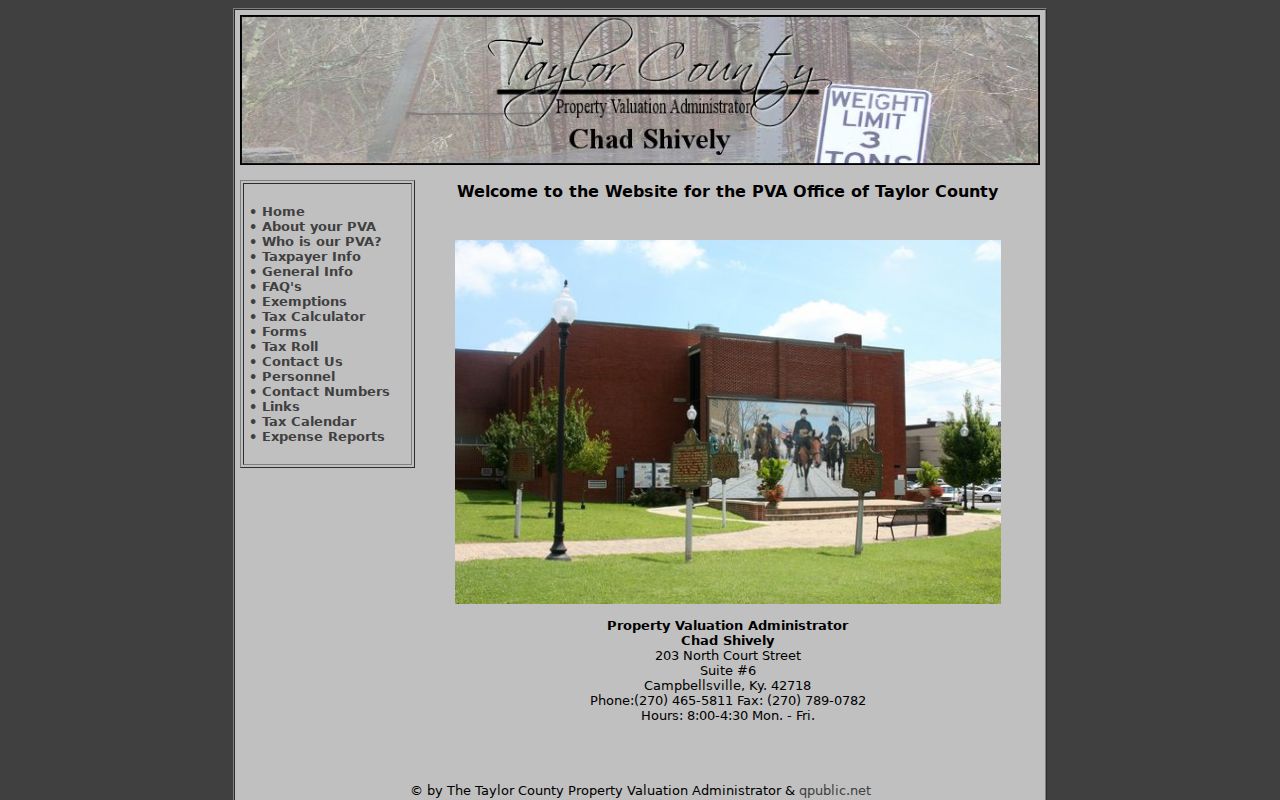
The official PVA page routes you to the office's live parcel search. Use it directly or visit the courthouse for current details.
| Current Owner | Tax-roll owner at the report date |
|---|---|
| Location / mailing | Situs and notice addresses, which may differ |
| Map/account/PID | Exact keys for cross-reference |
| Deed book/page | Bridge to the Clerk's instrument |
| Class, acreage, district | Assessment and tax context |
Taylor Landrecords Is Free, but Account-Based
The Taylor County Clerk portal is free, but account-based. New users must register, and everyone signs in on each visit. Its terms bar systematic downloading and data mining, and the home screen notes ongoing duplicate-document cleanup. Free access simply does not mean unlimited bulk use.
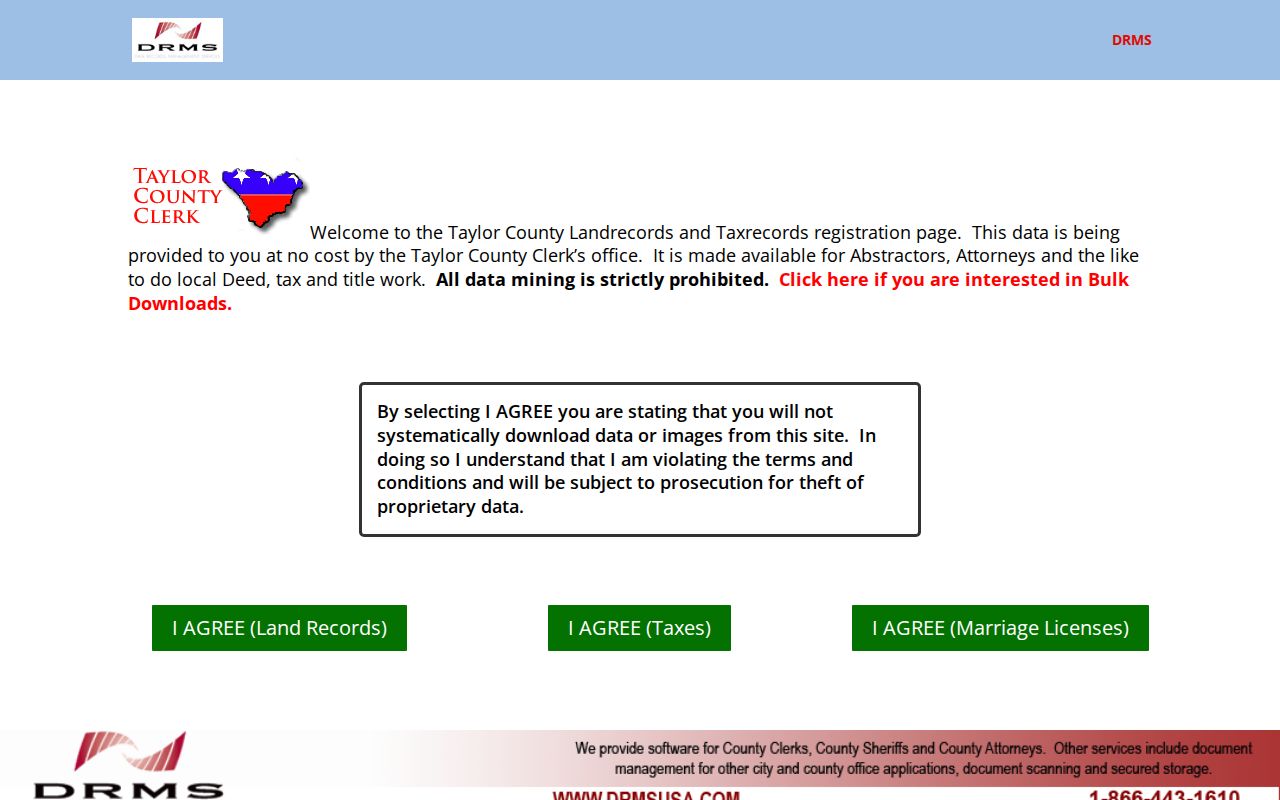
The portal entry confirms the current official route. For document coverage and copy service, the Clerk's recording and copy pages govern.
| Portal key | What it finds | Caution |
|---|---|---|
| Grantor | Documents given by a named party | Try name variants |
| Grantee | Documents received by a named party | Entity or estate style matters |
| Date range | A likely recording period | Signing and recording dates differ |
| Book type / page | A record series or known reference | Current options need sign-in confirmation |
Records That Build a Taylor County Property File
No single document tells a property's whole story. Taylor County property records work as layers. The custodian and access channel change with the question you ask.
| Record Type | What It Documents | Kept By | Access |
|---|---|---|---|
| Deeds | Transfers, parties, legal description | County Clerk | Index, images, counter, copy request |
| Mortgages and liens | Recorded claims and releases | County Clerk | Land-record index and books |
| Assessment | Owner, parcel, value, class, acreage | PVA | qPublic, phone, office |
| Current and delinquent tax | Bill, status, notices, later sale process | Sheriff / Clerk | Tax portal, office, posted lists |
| Plats and parcels | Lot, tract, map context, dedications | Clerk / PVA / planning | Map, recorded plat, counter |
| Property litigation | Foreclosure, title, partition, probate | Circuit Court Clerk | KYeCourts and complete case-file request |
For the transfer chain, use the Taylor County deed records route. Value and payment questions belong with assessment and tax records. A boundary question must reach the recorded deed or plat, and sometimes a licensed survey.
Taylor County Deeds Cross the 1990 Image Line
The Clerk's copy page lists the image cutoffs. Deed images run from 1990, marriage images from 1980, and other records such as mortgages and powers of attorney from 2000. Those are image start dates, not the start of the legal index. For an earlier chain, begin online. Then ask the office for the historic grantor-grantee index, deed books, microfilm, or archive location. Bring names, a year range, the legal description, and the last known book and page. Ordinary and certified copies are different products. Certified copies are listed at $5 flat. The ordinary page fee displays unclearly and should be confirmed with the office.
Note: A blank browser result may mark an image boundary, not the absence of a recorded deed.
Taylor Tax Records Move Between Two Offices
The PVA sets the assessment, the Sheriff collects current property taxes, and the Clerk receives delinquent bills after the transfer stage. The Sheriff's page links the exact current portal and warns users to permit popups. Its rendered field list was not captured, so the office is the fallback for bill year, amount, district, payment, or receipt questions.
The PVA assesses annually at fair cash value as of January 1 and physically examines property at least once every four years. It does not set tax rates or collect bills. A missing bill does not remove the payment duty, and current delinquent-sale dates should be taken from current Clerk notices rather than an old annual schedule.
Taylor County Parcel Lines Are Reference Lines
The PVA map can orient a parcel and its neighbors. But its lines exist for tax identification. Confirmed statewide routes include Kentucky Open Data, the Geography Network, and the KGS GeoPortal. The county offers no separate Taylor parcel viewer of its own. Use roads, imagery, zoning, and flood layers only when the source and metadata support them. A recorded plat may show lots, streets, easements, dedications, and revisions. When a line, access right, or vacation matters, a web outline cannot stand in for the plat.
- Parcel/APN
- An assessment identifier, not a deed.
- Plat
- A recorded map of lots and related features.
- Situs
- The land's location address, distinct from owner mail.
- Assessed value
- A tax-administration value, not a sale guarantee.
Campbellsville Labels Can Cross a City Line
Campbellsville is the county seat and the only incorporated city on the official roster. Its 2020 population was 11,426. Even so, Taylor County property records stay county-held. A Campbellsville ZIP or mailing label does not prove a parcel sits inside city limits. The city's subdivision authority extends one mile past its corporate boundary. County rules apply farther out. A tract can carry city planning papers. Yet it may sit in a county tax district with a county-held deed. For city-specific subdivision and permit context, use the Campbellsville property records page.
Main, Depot, and Central Avenue Link Old Records
Taylor County Museum's postal history traces Campbellsville's post office through several East Main addresses. They date between 1886 and 1903. It also shows that the old Depot street is today's Central Avenue. The town's original 1820 plat held just five lots. Details like these build a crosswalk for property records. Use them when a modern address turns up no old deed.
Work the current and historic street names together. Add the map-era number, the occupant or owner of record, and the town-lot description. Sanborn maps and city directories can pin down a building. The Clerk's deed books then show whether the parcel stayed whole or was split. Treat every archival clue as a lead, not proof of ownership.
Court Files Add Taylor Property Disputes
Taylor County court files sit at the Judicial Center at 300 E. Main Street. That office holds Circuit, Family, District, and Business court records. Begin with KYeCourts Guest. For the full case file, contact Circuit Court Clerk Susie Skaggs at 270-465-6686.
Property disputes surface here in many forms. Search foreclosure, lis pendens, quiet-title, and partition actions. Mechanic's-lien enforcement, judgment lien, tax sale, probate, and estate matters also appear. Note the case number, parties, filing date, category, and disposition. Then request pleadings, the judgment, sale order, commissioner report, or release as needed. A docket is only a pointer, never the whole file.
Title Watch Is Taylor County's Current Fraud Lead
The County Clerk posted Title Watch instructions in July 2025. Read the current terms before enrolling. Signup fields and fees can change. The service sends notice when a new document is indexed against your name. It cannot block a recording or rule on validity.
Kentucky's Safe at Home program lets eligible survivors substitute a lawful address. A missing or swapped address in deed records may reflect that protection. It is not a portal error. Report any questionable instrument to the custodian. Get legal advice when title rights are at stake.
Kentucky's 2026 Portal Deadline Needs a Taylor Check
Kentucky lawmakers set a portal deadline of June 30, 2026. County portals had to include specified instruments. These cover filings from June 30, 1966 through June 30, 1994. The covered list spans deeds, mortgages, plats, easements, restrictions, leases, powers of attorney, and wills. It also includes other title-affecting filings.
The public Taylor interface may not display the full span on its own. Use the deadline as a reason to test the current portal. Ask the Clerk about any missing deed image rather than guessing. A passed deadline is no guarantee. Every required item may not be visible.
Offline Taylor County Property Records Still Matter
The courthouse counter still matters. A terminal there may expose an older deed index or more images than the public portal offers. So ask before assuming the portal is complete. For phone or mail requests, list the parcel number, owner of record, book and page, approximate year, and document type. Settle the fee and certification question before payment goes out.
Kentucky's Open Records Act covers requests too. A written request can describe an existing record and seek inspection or copies by hand delivery, mail, fax, or email. Custodians generally answer within five days, not counting weekends, legal holidays, or exemptions. Never ask staff to create a title report. For older Taylor County property records, the public library, the museum, the Kentucky Historical Society catalog, and genealogy collections help track down old names and volumes. But none of it replaces the Clerk's certified record.
Build a Taylor County cross-reference packet.
Start with a cross-reference packet for Taylor County. It preserves the source, access date, query, and result date for every layer you use. Copy the owner from the PVA card exactly as displayed. Grab the location and mailing lines too. Then record the map number, account number, PID or PTID, acreage, property class, tax district, homestead flag, deed book and page. Add any sale-history reference. The official sample also shows an assessment disclaimer and the last certified-roll upload date. Those timestamps matter. They explain why a newly recorded sale and the assessment owner of record can disagree.
Next, pull the Clerk index entry and read the deed image itself. Write down the grantor, grantee, document type, recording date, book and page, and the land description. Preserve the wording of any legal description. Check for a subdivision, replat, tract division, road, adjoining owner, or earlier deed. If it names one, copy it verbatim. Don't substitute the current parcel number in your working notes. A parcel key is a useful bridge. But it is a later assessment identifier. It can change after a split or consolidation.
Add the Sheriff tax bill only when tax status matters. Note whether it is current or delinquent. The Sheriff collects current bills, while the Clerk handles delinquent material after transfer. Court dockets deserve the same caution. Pull one only when the parties, case type, dates, and property clues all line up. Foreclosure, partition, quiet-title, probate, and lien litigation may hold an order or commissioner report. That report may explain a transfer. A name match alone proves nothing about the subject land.
Finally, record what stayed unresolved. Some qPublic control labels lack clear answers. The separate Taylor parcel viewer and certain portal image spans lack clear answers too. The precise toll of the reported 1864 or 1865 courthouse loss is another open question. Labeling a gap beats filling it with a guess. A labeled gap tells the Clerk, PVA, court clerk, library, or archive exactly what to check next. Guesswork does the opposite.
Note: A compact packet of exact identifiers and dated sources is easier for a custodian to verify. It beats a broad request for everything about a property.
Exact Taylor Identifiers Prevent False Matches
Not every number in a Taylor County index is an APN. The county's own sample separates a hyphenated map number from the account, PID, and PTID values. Copy the exact label the source uses. Keep the punctuation and any leading zeros intact. A clerk, a tax office employee, or the mapping system will ask for one specific field. So the label matters as much as the digits.
A matching key is only the start. Before merging two results, compare the situs address, acreage, property class, tax district, deed reference, and legal description. Splits and consolidations complicate that. After a tract changes shape, the newer assessment number may bear no visual resemblance to the older one. The recorded description, with its book and page references, preserves the documentary path. And a single sample cannot prove that a prefix marks Campbellsville. Nor can it prove that every Taylor County parcel follows one fixed parsing rule.
Limits of Taylor County Property Records
Taylor County property records are powerful, but limited. A search can surface an assessed owner, a recorded deed transfer, tax status, a map reference, a plat, a lien, or a court event. What records cannot do is guarantee title, mark a legal boundary on the ground, set a sale value, prove occupancy, or reveal an interest that was never recorded. Dates and update cycles matter.
Lawful use. Use Taylor County property records for lawful due diligence, boundary research, house history, estate work, and civic review. A records search is not a title search or survey, and owner data must never be used to harass or harm anyone.