
What Taylor County Property Tax Records Contain
Two linked systems produce Taylor County property tax records. The Property Valuation Administrator is called the PVA. It keeps the assessment roll and the parcel facts behind it. The Taylor County Sheriff turns those values and local rates into current bills. That office then collects the money. The Clerk takes over sheriff bills after the statutory transfer. The three records are easily confused. An assessment, a current bill, and a delinquent account are distinct documents. Treating them as one leads owners astray.
| Record field | What it tells you | Official source |
|---|---|---|
| Assessment and class | Annual fair-cash-value assessment and property class | Taylor County PVA |
| Parcel facts | Map/account/PID, acreage, description, situs, and deed reference | Taylor County PVA |
| Exemption status | Homestead flag and other approved assessment relief | Taylor County PVA |
| Current bill | Amount billed, payment status, and receipt details available in the live system | Taylor County Sheriff |
| Delinquent account | Transferred bill, notices, purchaser information, and sale material when posted | Taylor County Clerk |
The PVA applies a standard called fair cash value to real property each year. That figure drives taxation. Yet it is not a certified appraisal. It is no promise of what a buyer would pay either. A tax bill layers district rates and taxable treatment on top. For more on how these figures differ, see the Taylor County property value guide.
Keep the parcel and the year constant when comparing records. Start with the PVA card. Confirm the map or account number, the PID, and the location address. Then match the assessment year, tax district, and exemption flag against the bill year the Sheriff shows. An amount appearing only in the Clerk's delinquent system deserves extra care. Transfer status and the current custodian matter before any conclusion. A deed reference or sale-history entry may explain a name change. But neither serves as a receipt. A homestead flag, in the same way, does not prove every exemption was approved. Those distinctions keep the Taylor County property tax trail tied to the right record.
Taylor County Property Tax Duties Split Three Ways
Each custodian controls one stage of the tax record. The PVA office, led by Chad Shively at 203 North Court Street, Suite 6, sets assessments and answers exemption questions. The Sheriff's office in Suite 7 collects current bills. The County Clerk, also at 203 North Court Street, handles delinquent bills after transfer. No office can substitute for another.
PVA
Ask the PVA about value, parcel facts, classification, ownership on the tax roll, and exemptions. Call 270-465-5811 weekdays from 8 a.m. to 4:30 p.m.
Sheriff
Ask the Sheriff about current bills, payments, or receipts. Phone 270-465-4351; weekdays run 8 a.m. to 4:30 p.m., with Saturday hours 8 a.m. to noon.
For a transferred delinquent bill, call the Clerk at 270-465-6677. Provide the address, owner, parcel number, and bill year. Specific details let staff locate an existing record rather than research a broad question.
January 1 Starts Taylor County Property Tax Assessment
The PVA FAQ names January 1 as the assessment date. Taylor County revalues real property every year. It physically examines each parcel at least once every four years. Sales, additions, fire damage, and wider market movement can all shift a later value. The PVA studies transactions closely. It does not create the market, set the tax rate, or collect the resulting bill.
A parcel card is a dated tax-roll snapshot. The official sample shows the assessment year and rate information. No live refresh timestamp appears on it. If something changed near the assessment date, ask the PVA which condition facts the current roll reflects. Ask about the ownership facts it reflects too.
The annual cycle also shapes what evidence helps. A dated photograph, survey, repair record, sale document, or comparable sale may explain the property's condition in the relevant period. It may also explain the classification in that period. The PVA decides what the process accepts. Keep the notice envelope and note the date it arrived. For a factual error such as acreage, class, or an address mismatch, name the exact field. Do not argue from the final bill. The Sheriff's staff can explain collection details. An assessment correction still begins with the PVA.
Read Taylor County Property Tax Assessment Fields
Start with the Taylor County PVA/qPublic page. That page hosts the county's live parcel search. The field descriptions follow the official sample parcel card the county publishes rather than the live interface.
| Verified card field | How it helps with tax research |
|---|---|
| Map number and account/PID/PTID | Carry the exact parcel key into a bill or office request. |
| Location and mailing address | Separate the taxed site from the destination for notices. |
| Tax district and rate/year | Identify the district context and dated rate shown on the card. |
| Class, description, and acreage | Check whether the assessed property facts match the parcel. |
| Homestead flag | See whether that status appears on the sample-style card. |
| Deed book/page and sale history | Cross-check a recent transfer without treating it as the tax bill. |
The sample format 53-039-03 and its account identifiers show why exact copying beats guessing how Taylor County parcel numbers are built. Keep the punctuation and leading zeros intact.
Look Up a Taylor County Property Tax Bill
The Sheriff links straight to the current Taylor County Property Tax Info portal. Browser popups must be enabled for it to work. The portal's labels, covered years, payment fees, and result columns can change. Confirm them in the live system. A generic tax-site workflow will not match every county's setup.
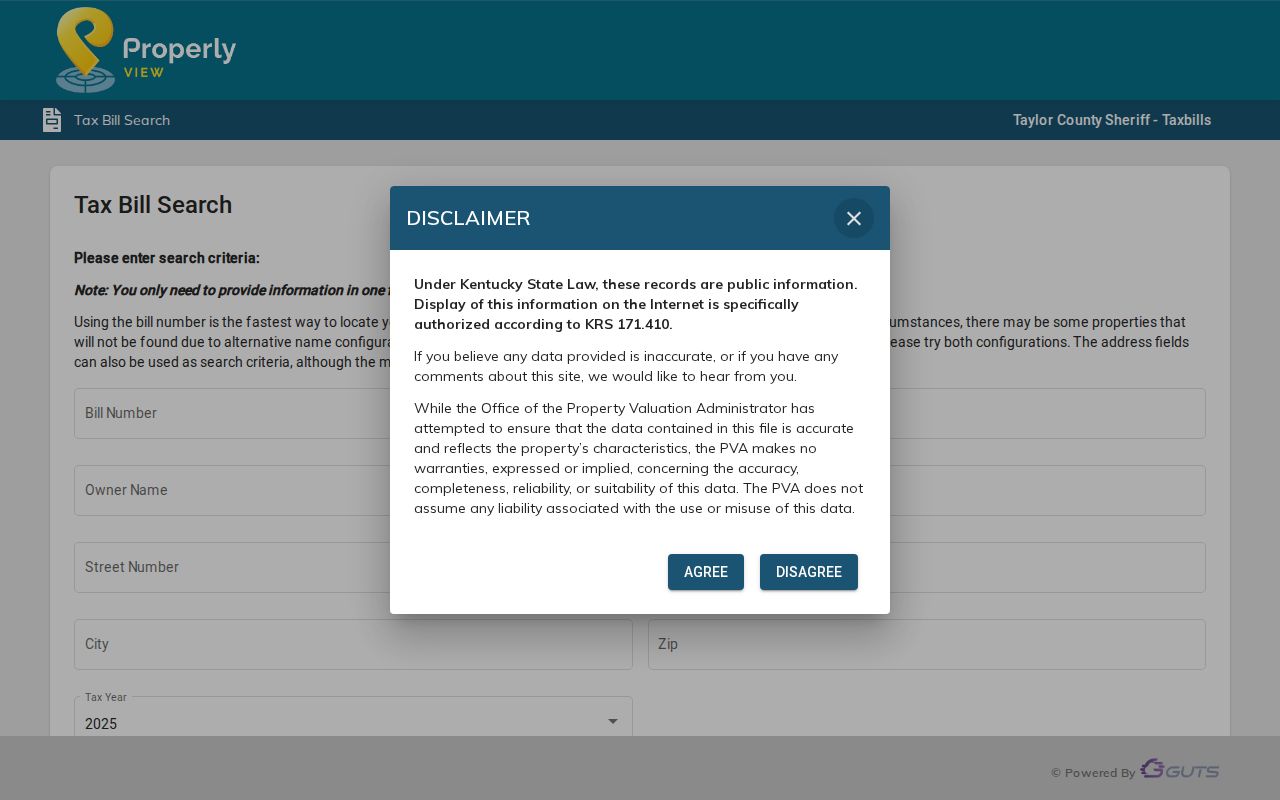
The portal's landing view identifies the official bill system. Current amounts and payment status still come from the live results and the Sheriff's office.
- Open the Sheriff's official portal and use the available address, name, or parcel control shown there.
- Match the parcel identifier and situs to the PVA card before relying on the bill.
- Read the bill year, amount, taxing-district detail, and payment status that the live result provides.
- Check exemption status with the PVA, then ask the Clerk if an older unpaid bill has transferred.
- Assessed value
- The PVA's annual value used in tax administration, subject to applicable taxable treatment.
- Levy or tax rate
- The rate applied by the relevant taxing authority, not a value chosen by the PVA.
- Homestead exemption
- Assessment relief for a qualifying applicant whose approval should be checked with the PVA.
- Tax lien
- A legal claim tied to unpaid taxes, distinct from a routine current bill.
When the portal stalls, the Sheriff's office is the fallback. Call the counter directly. You can also try mail, fax, or email for a precise request on an existing record. Confirm the method with staff first. A Kentucky Open Records Act request can describe a specific bill or receipt. It cannot force staff to compute a title or tax conclusion.
Have your details ready before you call. Give the owner of record's name. Include the property location, the parcel number, and the bill year. Name the exact item you need, like a payment status or receipt. Ask whether the answer covers the original current bill or a transferred delinquent account. If a payment window or result page will not load, do not drift to a similarly named portal from another state. Return to the Sheriff's official Taylor County link, or simply call the office.
Taylor County Property Tax Exemptions Change Taxable Treatment
Homestead, disability, and agricultural programs all run through the PVA's forms and guidance. An exemption never rewrites a property's arm's-length sale history. It does not make the Sheriff the decision maker either. Instead, it changes assessment treatment. That shift applies when both the owner and the property qualify under the applicable rule. The Taylor PVA forms page is the official application route.
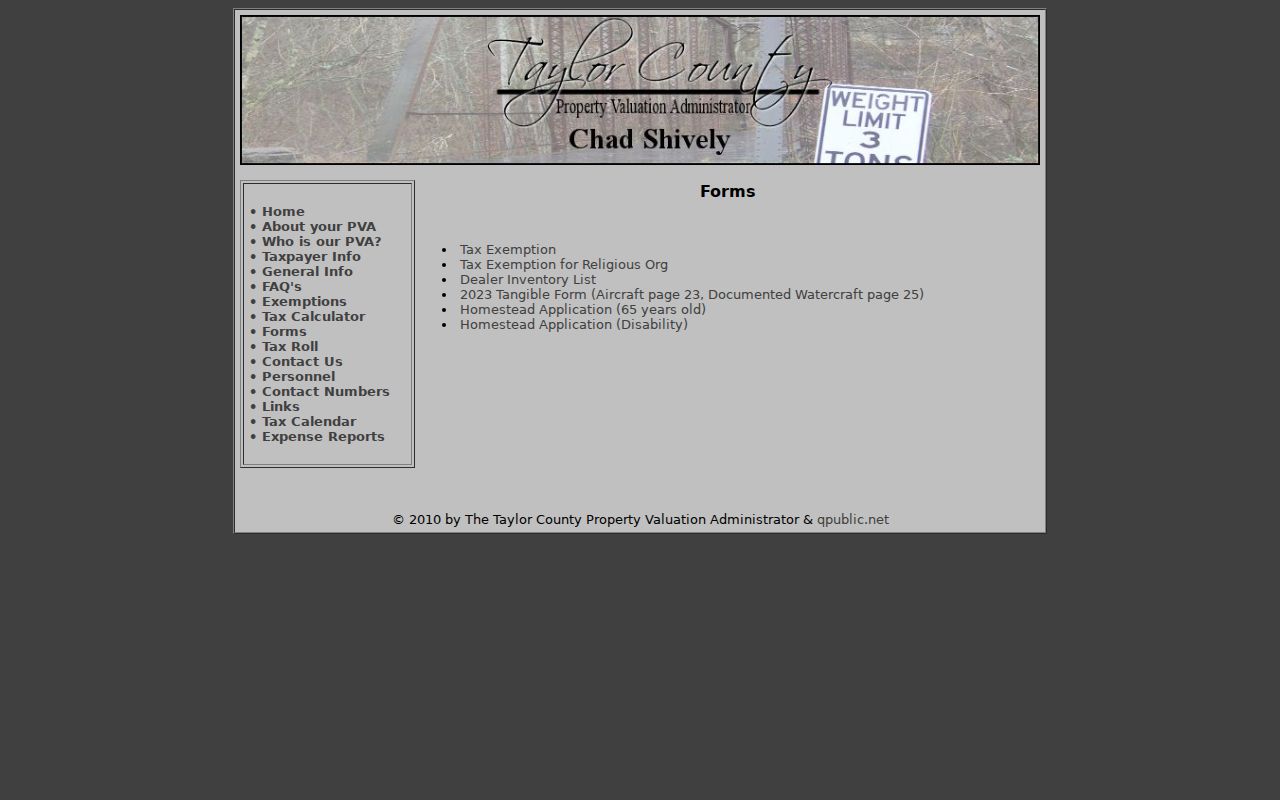
Bring eligibility questions, forms, supporting documents, and status checks to the PVA office. The Sheriff can explain what a current tax bill shows. Only the assessment office can correct assessment or exemption data. A missing notice does not erase the obligation. Fix address problems with the PVA and payment questions with the Sheriff.
Taylor County Property Tax Delinquency After April 15
After April 15, delinquent sheriff bills transfer to the Taylor County Clerk. The Clerk then mails required letters. It publishes notice and posts list and sale information as the event nears. Third parties may purchase eligible delinquent tax claims under Kentucky's process. A current Clerk notice is time-sensitive, so never reuse a prior year's sale date. The Clerk's homepage itself has carried a delinquent-tax notice tied to a single week. That shows why Taylor County property tax records must be checked live. Use the American Land Records delinquent-tax search. Then confirm the bill and its present status with the Clerk.
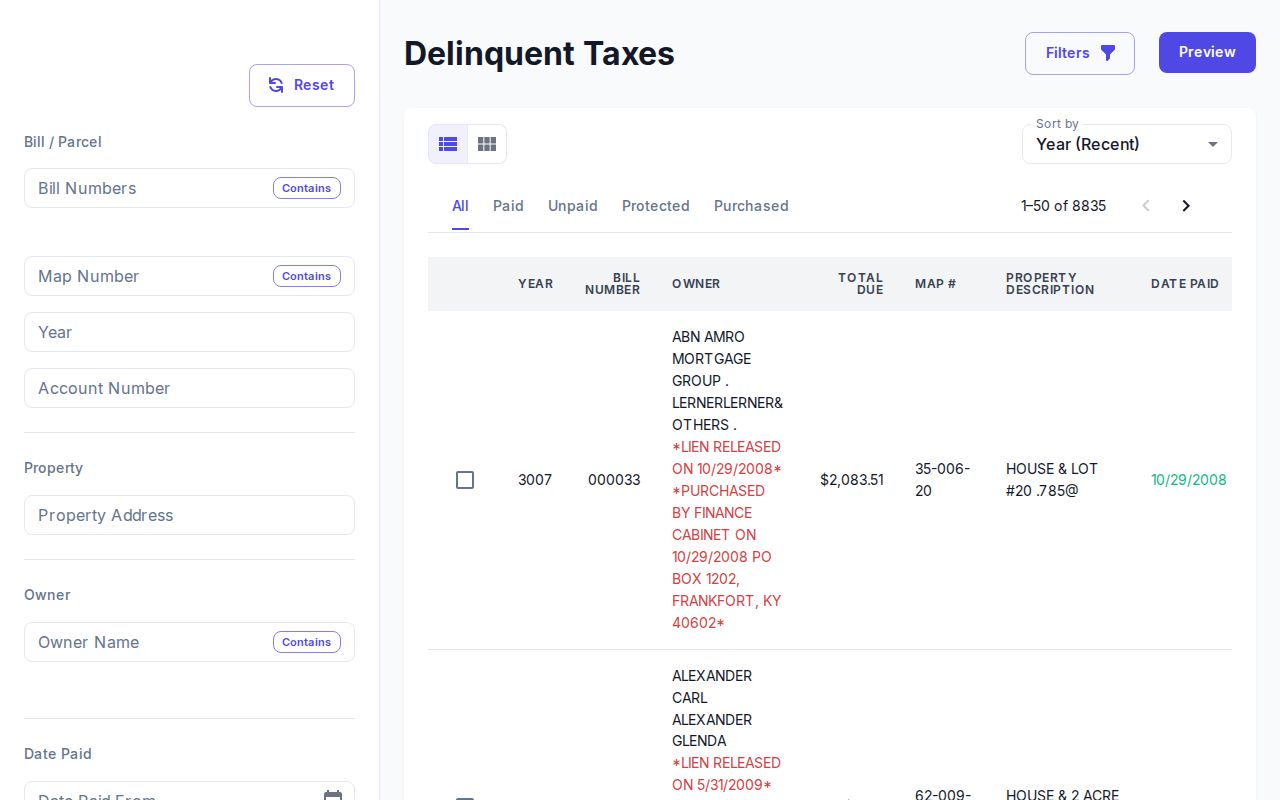
The portal view reinforces the handoff from current collection to the Clerk's delinquent record. It is a search aid only. It is not proof that a lien was released or that a sale remains scheduled.
Use Taylor County's Property Tax Appeal Calendar
Taylor County's PVA calendar puts inspection and conference activity in May. The Board of Assessment Appeals process follows. Exact dates shift with each assessment year. Check the current schedule rather than an old one. Start with the PVA, ask to inspect the property record, and bring evidence tied to the parcel's condition, class, acreage, or comparable sales. Remember this. Disputing the later tax amount is not the same as challenging the underlying assessment.
Watch the annual window. Confirm the current May conference and Board deadlines with the Taylor County PVA before filing; an old calendar is not a safe deadline source.
The PVA calendar serves as the official checkpoint online. A portal or form that will not load should not stop you. Call 270-465-5811 or visit Suite 6 during weekday office hours instead. Keep a copy of the parcel card and the notice. Also save your supporting evidence and every dated filing.
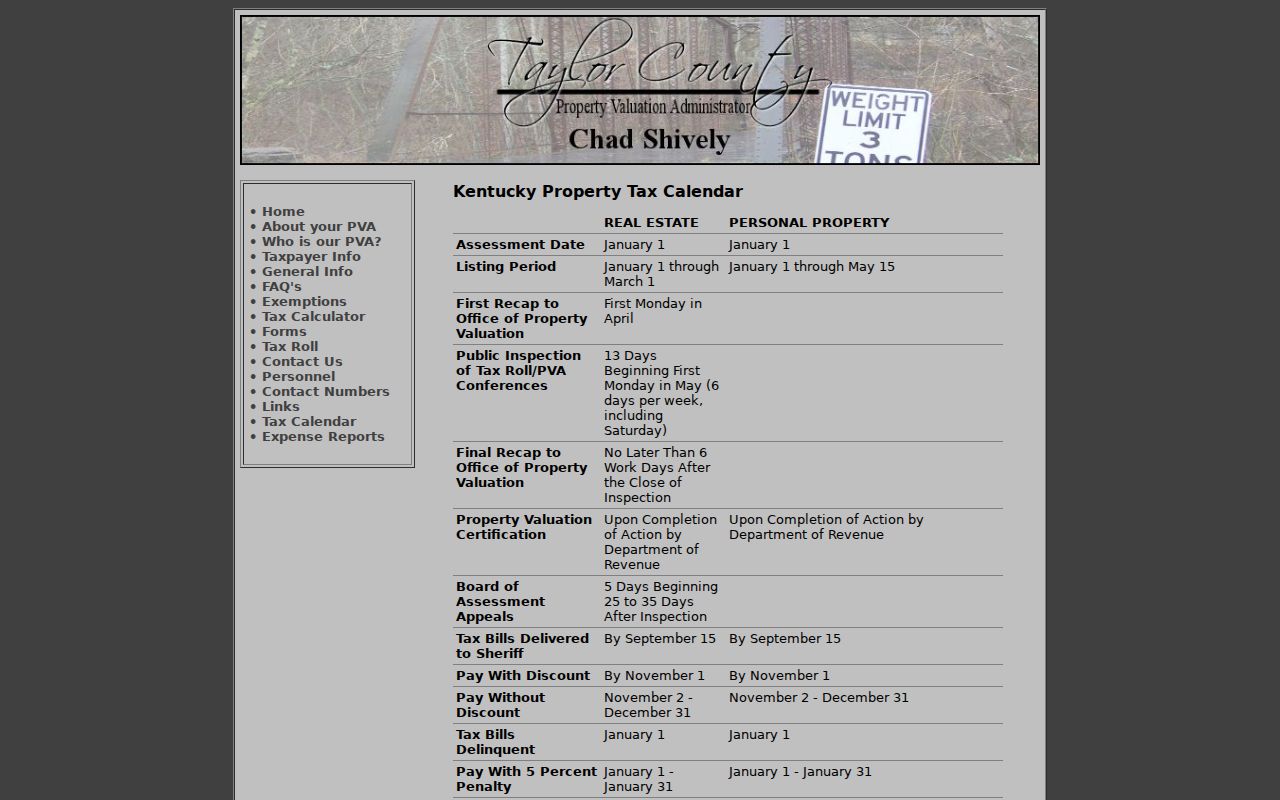
The posted schedule for the current year, not a reused date, should control your next step. Check the calendar each season.