
Taylor County Owner Record Fields
The Property Valuation Administrator's parcel card is the present-tense record for Taylor County. It labels the ownership line Current Owner. It groups that line with the mailing address, property location, map number, account or PID, tax district, acreage, deed book and page, and sale history. Those linked fields keep a name tied to the right tract. The live Schneider qPublic search restricts access. Confirm its current screen layout and refresh date at the portal or with the PVA before relying on it for anything time-sensitive.
| Current Owner | The name carried on the assessment roll |
|---|---|
| Mailing Address | The destination used for owner notices |
| Location Address | The parcel's physical or situs address |
| Map / Account / PID | Identifiers used to keep the card and map together |
| Deed Book / Page | The card's bridge to a recorded instrument |
| Sale History | Prior transaction entries shown on the sampled card |
An owner of record is not the same as an occupant. The mailing address may point somewhere else entirely. This happens often with a farm, an inherited tract, or an entity-held parcel. Mail delivered to the situs proves nothing about ownership either. Read the name and both address fields together. Then let the deed reference carry the legal-record trail.
Check Taylor County qPublic
Open the Taylor County PVA site and follow its property-search link. The vendor describes searches by name, address, and parcel number. The Taylor sample confirms which local card fields matter. Start with an exact street address. If that fails, try the owner name. Or use an exact map, account, or PID copied from a tax notice or deed. Treat the generic qPublic result columns with caution. Some controls may not be active for Taylor County. So verify what the portal actually offers before drawing conclusions. The PVA office sits at 203 North Court Street, Suite 6, in Campbellsville. Staff answer the phone at 270-465-5811 during weekday hours of 8 a.m. to 4:30 p.m. Phone or counter help is the best fallback for a blocked parcel card. It also works when a card is missing or hard to match. Give the address, any known owner, and the parcel identifier. Do not ask staff to research a title. For the local PVA's public information and tax-roll gateway, see the Taylor County qPublic source shown here.
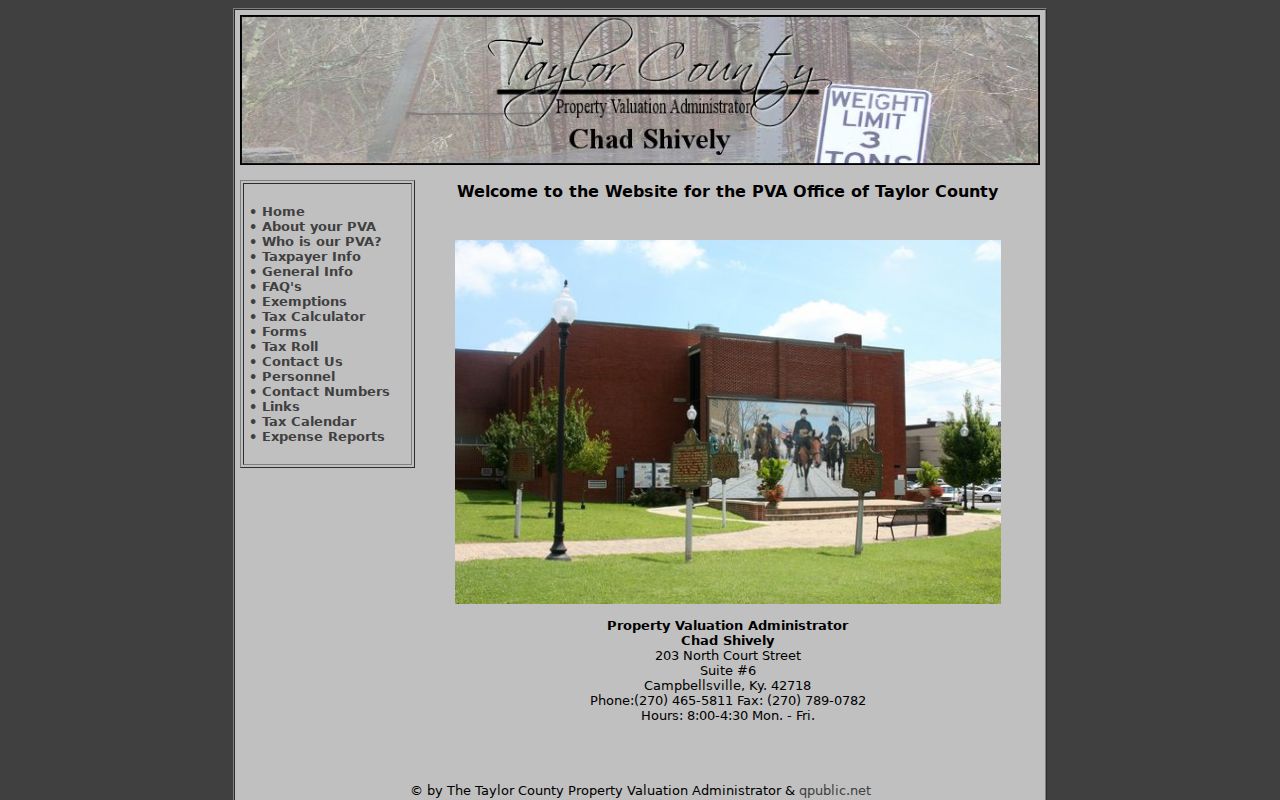
The county office route confirms the owner name, yet a deed check still matters whenever recency is in question.
Taylor Owner Record Freshness
Kentucky PVA real property is assessed each year, with January 1 as the assessment date. The Taylor PVA also revalues property annually. It physically examines property at least once every four years. That schedule serves the tax roll. It does not guarantee same-day accuracy for a newly closed sale. The sample parcel card includes a last-upload field. The current Taylor County upload timestamp should be confirmed directly. Every current-owner result carries a date question. After a recent transaction, compare the card against the County Clerk's recording date and latest deed. The recorded deed may be newer than the certified roll. A signed but unrecorded deed poses another limit. Neither the public index nor the roll can show it. The information has not yet reached the custodian.
Recency check. A Taylor County assessment card can lag a recent sale; use the newest recorded deed to confirm the current grantee.
Taylor Situs and Mailing Clues
The location address, usually called the situs, identifies where the parcel lies. The mailing address is where the PVA sends owner notices. The two lines may match, but no rule requires it. Rural routes, post-office boxes, out-of-county owners, and entity addresses all create mismatches. None of these creates an ownership problem. Taylor County postal names add one more trap. Campbellsville, Elk Horn, and Mannsville-area postal clues do not settle municipal boundaries. Search the street and parcel number first, then check the owner and deed. Some old records give a legal description only. No modern street appears. The map number and deed book/page then link better than any guessed ZIP. Note: A Taylor County mailing line is a contact clue. It is not proof that the named owner occupies the property.
Confirm Taylor County's Current Owner
The Taylor County Clerk recording office records deeds and assigns each lodged instrument a book-and-page reference and index entry. Its deed index supplies the legal-record check for the PVA name. This workflow confirms a current owner only; it is not a full chain-of-title search.
- Read the Current Owner, location, mailing address, PID, and deed reference on the PVA card.
- Search the Taylor County Landrecords portal for the newest conveyance tied to that name and tract.
- Match the grantee, legal description, recording date, and book/page. A grantee is the party receiving the interest.
- If the names conflict, call the PVA and Clerk with the exact identifiers and dates. Preserve both records and their retrieval dates.
- Owner of record
- The party named as owner on the official roll.
- Assessment roll
- The PVA's annual property list used for assessment work.
- Situs address
- The physical location label, distinct from the owner's mailing address.
- Recording lag
- The time between a transfer, its recording, and later changes in another county system.
Entity Owners in Taylor County
A Taylor County parcel card sometimes shows an LLC, a trust, or an estate. It may show these rather than a person's everyday name. Copy the spelling exactly as shown. It does not replace the deed. But the Kentucky Secretary of State Business Entity Search confirms an LLC's name and pulls up its filed documents. Its start screen offers a search-mode selector and a search text field. It also offers an option to limit results to active entities only.
Trusts and estates take other routes. A trust may not be a Kentucky business entity at all. So the deed's grantee style and its trustee wording do the real work. An estate transfer can require the Taylor probate file. It can also require proof of the personal representative's authority. The later executor or heir conveyance may be needed too. Those records explain authority, not title. The deed still supplies the ownership link.
For entity research, the state business search presents the official starting screen.
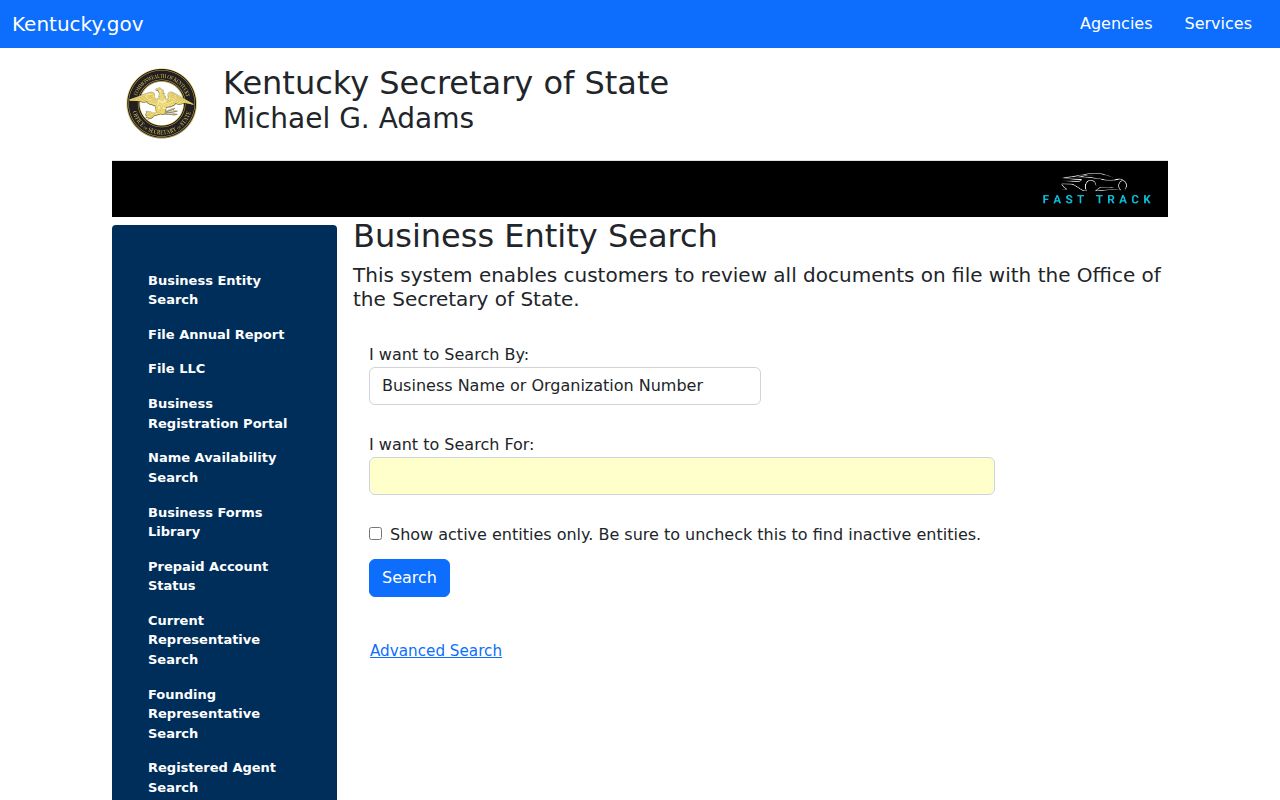
The state business search settles an LLC's filed name. The Taylor County deed then ties that entity to the parcel.
Taylor Ownership Versus Liens
Liens cluster near an owner's name in the Taylor County Clerk's index. Mortgages, releases, and lis pendens sit there too. Not every indexed item transfers title. A mortgage only secures a debt. A release can clear a recorded claim. A lis pendens gives notice of pending litigation. The grantee on the latest valid conveyance is the ownership clue that matters, not every party indexed against the land.
That line keeps a current owner search from drifting into a lien-clearance opinion, since a missing portal hit proves nothing and the PVA card was never built to list every encumbrance. When clear title is required, get professional title work rather than treating the tax roll as a certificate.
Protected Taylor Owner Addresses
Kentucky's Safe at Home program lets qualifying crime survivors use a substitute address that state and local agencies must accept. It also forwards mail. Voter registration can be shielded too. So a missing or substituted physical address may be lawful protection rather than a flawed Taylor County owner record.
Use the public mailing route only for a legitimate property matter. Never try to defeat a redaction. Never hunt for a protected home address. The newest deed and owner name still answer most parcel questions without exposing what an agency withheld.
Lawful Taylor Owner Contact
The mailing address on a public assessment card is the normal contact clue for a boundary dispute, purchase inquiry, or shared access issue. Write plainly. Name the parcel matter. Respect any request for no further contact. If the online card fails, ask the PVA for the existing public record through its phone, counter, mail, fax, or email channel. Staff will not hunt down a private address.
Kentucky's Open Records Act allows a qualified request for an existing record by hand delivery, mail, fax, or email, subject to exemptions. It does not force an office to run a title search or invent an answer. The full owner-finding route sits on the Taylor County ownership method page. Historical names belong on the former owners page.
Lawful use. Taylor County owner records support property diligence and civic research. Never use an owner name or address to harass, threaten, or harm anyone.